Another haiku
A second day in a row?
You must be joking.
Monthly Archives: May 2012
A Haiku
Here is a haiku I wrote showing my deep internal struggle between my desire for warm chocolate chip muffins and my lack of motivation to actually bake them.
Chocolate chip muffins
If I wasn’t so lazy
I would bake some now
Approximate Efficiency and Reliability of the DMV
 |
| Click the image for larger version |
Some Not Very Profound Thoughts On Technology
The progress of technology doesn’t always turn out the way we would expect it to. Sometimes it does, like with the development of computers. People said that eventually you would have personal computers the size of your hand, which turned out to be true, considering smartphones today. However, many technologies didn’t follow a logical developmental progression – two examples are the radio and the oven.
Radios today have been improved upon not by smaller or more high quality radios (although they do exist), but rather by internet radio services such as Pandora. From the perspective of the early 1900’s, it is difficult to predict that the development of the radio would lead to personalized internet music streaming, which isn’t really radio at all.
Similarly, the development of the microwave oven is not a logical successor to previous technologies. The microwave, unlike previous cooking devices, doesn’t use direct heat, but rather high-powered radio waves.
By confining what we expect tomorrow’s technology to be based on today’s standards only puts limitations on the future. The biggest inventions and creations won’t simply be an improvement on current technology, but rather completely new perspectives on existing problems.
Professional Monopoly
While discussing the dangers/humanity of college football, renowned author Malcolm Gladwell asked:
“What on earth is so special about football? What if years ago people started playing Monopoly?”
I find this to be a fantastic idea, and it makes me laugh just thinking about what professional games of Monopoly would look like. I imagine them to be similar to poker, where fancy on-screen graphics depict the situation on the table, with a narrator commenting in a soft, calm voice.
“Oh, nice play there; Adams rolled a solid 8 to land him just past GO. It’s not really his playstyle to save his cash early on, not sure what his strategy is. Most players at this level will try to scout out there opponents before making any risky investments. He’s definitely eyeing that Park Place, but someone else might get to it first. And here he passes the dice to undefeated player this season Thomas Andrews…”
And why stop there? Professional Candy Land would get pretty intense, and I would watch it over golf any day.
Caution Children
There are three ways to interpret the yellow “Caution Children” sign:
1. CAUTION: Children

2. Caution, children.

3. CAUTION: CHILDREN!

Line Calls
In tennis, the goal of the game is to hit the tennis ball over the net and within the lines on the other side of the court. Most of the time, it is obvious to both players whether the ball is “in” or “out”. The goal is to hit the ball to where to opposing player cannot return it, which is often the edges of the court, meaning that the ball frequently lands on or near the line. The official rule in tennis is that the returner gets to call if the ball is in or out.
One time when playing tennis I hit a very nice serve which lands just on the line, bouncing out of the reach of my opponent. Just as I clench my fist in joyful victory, he calls “out!” Knowing the rules, but also knowing the exact position of the ball, I walk closer to the net and ask if the ball really was out. He confirms that it was, and I pressure him to point to the spot where the ball landed. He of course points to the spot just outside the line, and continues to declare that my serve was indeed out. I say, “Alright, I’ll give it to you, but just so you know that serve was in.” He didn’t appreciate my comment very much.
In summary, the ball landed in a specific position, which was unaffected by the call of my opponent. Whether he saw it as in or out doesn’t affect the position of the ball, which, of course, was in.
M.C. Escher
M.C. Escher is probably my favorite artist of all time. Most of his drawings are black and white pencil sketches that make little physical sense. When looking at one of his pieces, the common first impression is to notice that it’s well done and looks pretty cool. If you look at them for more than three seconds, you start to realize that the drawn scene is not possible in spacial reality. This confuses some people, but the easiest thing to do is look at the image part by part and see where you get confused. In the picture below of the infinite waterfall, you can split the scene into two parts: where the water flows “down” the ramp, and where it falls down the waterfall. Each of these separate images make sense, but when placed in the same scene, their perspectives conflict and they look (and are) impossible. Then if you look at the legs of the two towers, you realize how insane the picture actually is. Similar to the waterfall drawing, the staircase image is just as perplexing. It is easy to split each little part of the sketch into realistic parts. However, when they are combined in this way, they distort the viewer’s sense of space and dimension. Some people can’t stand to look at them because they shouldn’t make sense. But maybe the better option is to simply accept that they can’t exist and appreciate the confusion.


Playground Equipment
A lot of people are concerned about the health and safety of American youth, especially since child obesity is on the rise. Although there are many issues contributing to a less healthy lifestyle, including more processed/junk/fast food, television, and videogames, the motivation for kids to exercise is taken away by the very people who want to improve children’s health.
With efforts to make playground equipment more safe, they have only made it less fun. I remember the merry-go-rounds that would spin extremely fast. Kids would frequently be whipped off of them by centrifugal force, and get serious scrapes and bruises. The danger involved in this playground activity is what made it fun; plus, the movement involved in spinning it up made it great exercise. Nowadays, playground equipment is made so it is nearly impossible to get hurt without trying. Slides and swings and little steppy things are fun, but they lack the excitement of older playground equipment.
But if someone gets injured and isn’t able to run around then they can’t really exercise until they are healed. I guess I just feel biased towards the merry-go-round because I enjoyed seeing other kids get flung through the air.
 |
| The Classic Merry-Go-Round |
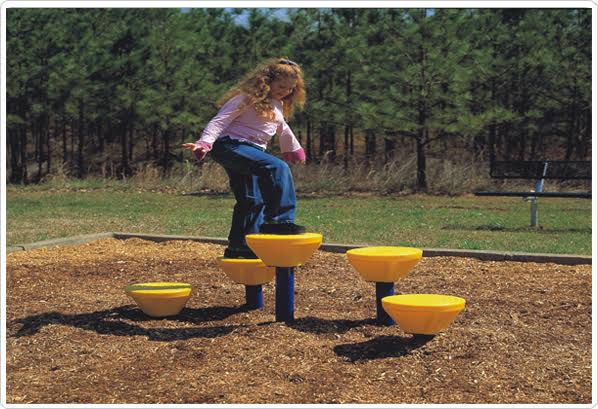 |
| “Little Steppy Things” |
Texting and Walking
When people hear ridiculous or seemingly crazy things, they tend to criticize without thinking about the motivation behind it.
This is most easily seen by silly laws in certain cities/states. For example, there is a law in some town that bans riding a bike in swimming pools. This is hilarious, as you cannot ride a bike in a swimming pool because you would sink! What a ridiculous law! But wait, if you were to think about it, you may realize that just because it’s a swimming pool doesn’t mean it has water in it. If you’ve ever seen professional trick or stunt bikers, they do they’re runs in skateboard parks that very closely resemble empty swimming pools. This law doesn’t seem so ridiculous anymore, now does it?
Another more recent and probably more difficult law to understand is the one in some state that banned texting while walking. That is so silly! How could they make it illegal to text and walk at the same time? Well, to figure this one out, try to consider the dangers of texting while walking – you could bump into someone else or maybe a pole. This seems harmless enough. What’s the big deal? Or you might walk into traffic unaware. The purpose of the law is not to restrain people from texting and walking, but rather to place some fault on the pedestrian if they are involved in an accident while distracted by their cell phone.
Most things are not accidents or coincidences, although they may seem that way. Please stop and try to think about the motivations behind something seemingly ridiculous before criticizing it.
 Chocolate Frosted Sugar Bombs